The Step Across: The Real Cost To Trade A Unit For A House
The house looks cheaper than the unit in thirteen Australian markets. Then you pay stamp duty and every fee. Only four survive. Kent Lardner has costed the full move across 256 markets.

Kent Lardner has prepared a new FOUNDIT report that costs the full move from a unit into a house across every corner of Australia. Not the price gap between the two properties. The whole bill. Stamp duty on the house, commission and marketing on the unit, conveyancing on both sides, inspection, mortgage discharge and registration. Every fee that stacks up between one settlement and the next.
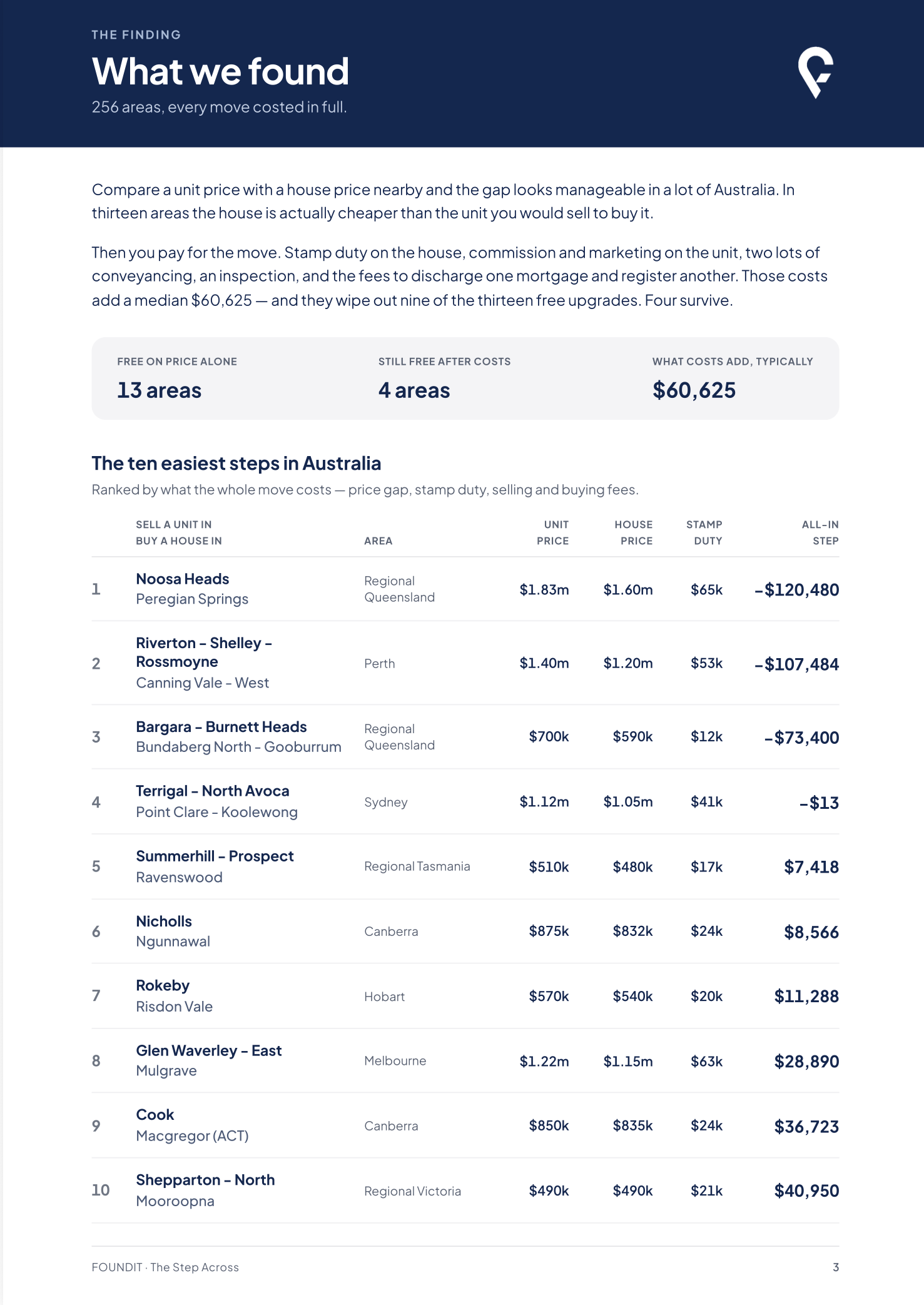
The report priced 4,808 possible moves across 256 markets. In thirteen of them, the house was already cheaper than the unit on price alone. Once the cost of the move was added, nine of those free upgrades disappeared. Four survived.
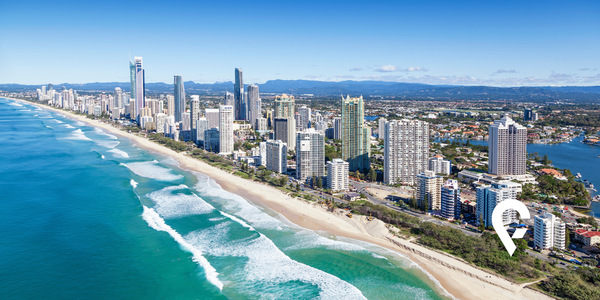
The biggest of them is on the Sunshine Coast.
A Noosa Heads unit changes hands at a median of $1.835 million. Ten kilometres inland, in Peregian Springs, the median house sells for $1.6 million. Pay the stamp duty and the selling costs and you still finish $120,480 ahead. It is the biggest free upgrade of its kind in the country.
Why the sticker price hides the real cost
Most property comparisons stop at price. Median unit here, median house there, subtract one from the other, and call the difference the cost of upgrading.
Medians are a good place to begin. They tell you the shape of a market, which suburbs are broadly in reach of which, and where the natural swap points sit. What they do not do is settle the bill on any single move, because the biggest cost of upgrading is not the price gap between the two properties.
Stamp duty is the largest single item, and it is charged on the full price of the house you buy, not on the price gap you are funding. Sell a $650,000 unit to buy a $750,000 house and the duty is levied on $750,000. A $100,000 price gap is rarely a $100,000 move.
Add agent commission on the sale at around 2.2%, marketing and styling in the range of a few thousand dollars, conveyancing on both sides, a building and pest inspection, and the mortgage discharge and registration fees. Across the 4,808 unit-to-house moves priced in this report, the total transaction friction lands at a median of about $76,849, or roughly 6.3% of the purchase price. Real numbers will move around that depending on the agent, the state, and the deal, but the shape holds up.
The four Australian markets where the house is genuinely cheaper
FOUNDIT compared every viable unit-to-house move inside each ABS statistical area in the country. In thirteen markets, the house was cheaper than the unit on price alone. In four of them, that saving was large enough to absorb every cost of the move. The biggest is Peregian Springs. The report names the other three, ranks them in order, and shows exactly how much you keep after every cost is paid.
Stamp duty is where the money goes
Duty does most of the damage on the average move. It is also the least evenly applied cost in the country.
In Victoria, the median stamp duty on a qualifying move works out to 5.5% of the purchase price. In the ACT it is 3.6%. On identical prices, the buyer in Melbourne pays more than double the buyer in Canberra, and never sees the money.
State by state, the median duty on a unit-to-house upgrade currently looks like this:
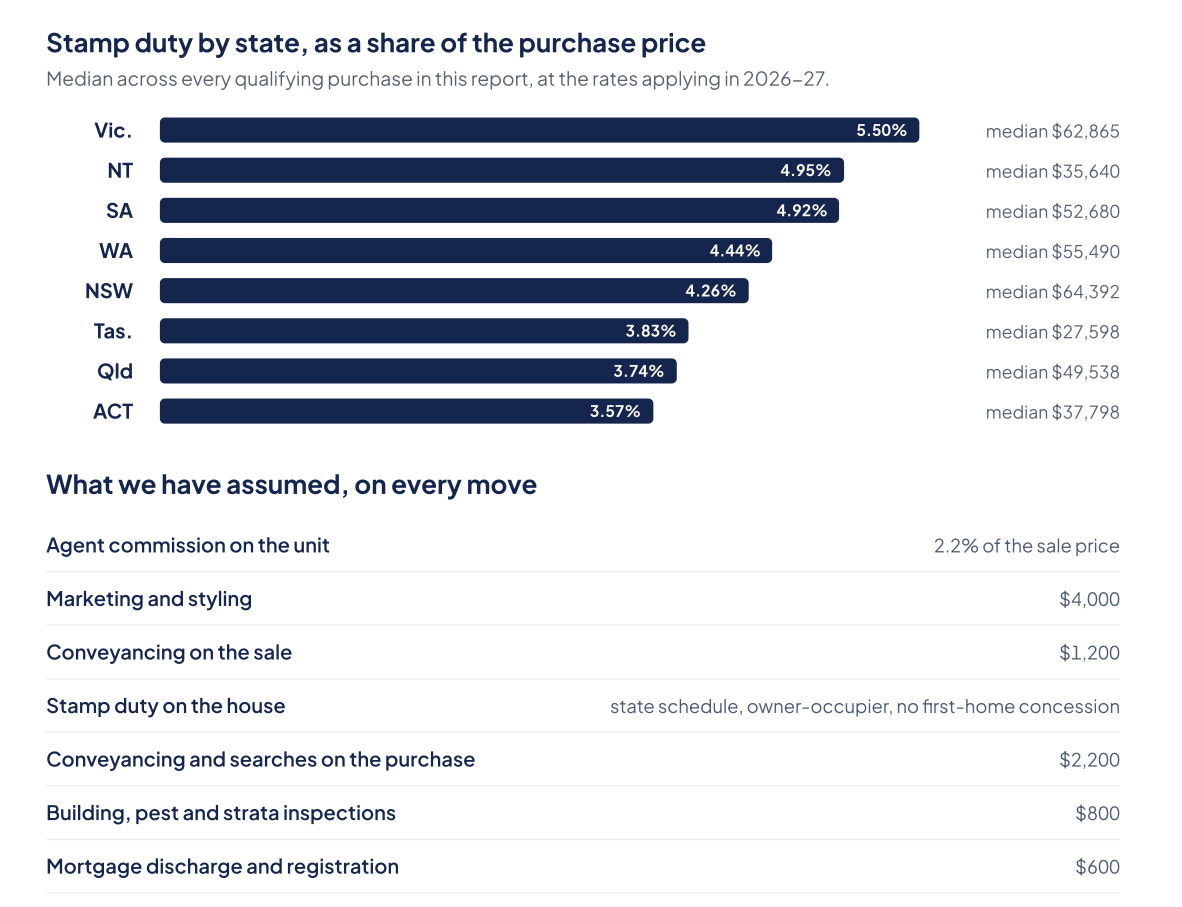
Nobody in this analysis is a first home buyer. They already own. Every first home concession in the country is therefore unavailable to them, and they pay the full owner-occupier rate.
How the numbers were built
Three tests decided what counted as a real move. Full method sits inside the report.
Both suburbs had to sit inside the same ABS SA3, so the mover stayed in the same part of the city or region. The two suburb centres had to be within 15 kilometres of each other. And the house suburb could rate no more than two SEIFA deciles below the unit suburb, so the swap was not a saving disguised as an upgrade.
That filter left 4,808 possible moves across 256 measurable markets, spanning every capital and every mainland region in the country. Stamp duty was calculated on each move using the relevant state or territory's 2026-27 schedule.
The trade-off nothing in the numbers can price
A unit and a house are not the same product.
Many of the units at the expensive end of this analysis are expensive for a reason. A water view, a beachfront position, a lift, secure parking, and somebody else maintaining the building and mowing the lawn. Sell in Terrigal, Applecross, or Noosa Heads and the outlook is a large part of what you are selling. It does not come back with the house.
What comes back is land. Another bedroom. A second bathroom. A yard, a driveway, and the freedom to alter the place without asking a body corporate. For an older couple who bought the unit for the view and the low maintenance, that is a poor trade at any price. For a family with two small children, it is usually the entire point.
The rankings in the report are the price of changing function, not the price of trading up.
Get the full report
The complete national ranking, every capital and every regional market broken out chapter by chapter, and the full state-by-state stamp duty table sits inside the free FOUNDIT report.
What's inside the twenty-page report
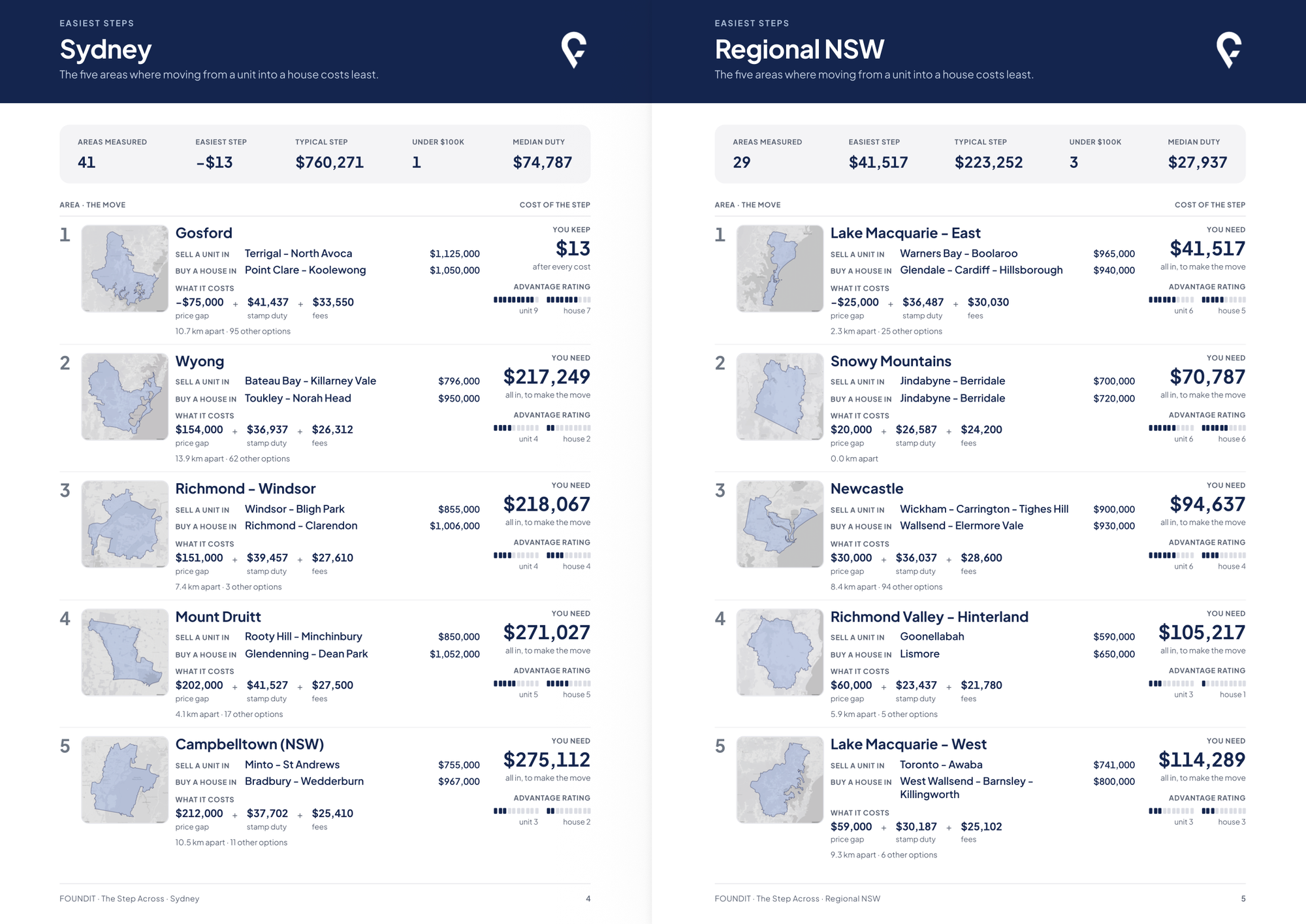
The top ten easiest unit-to-house steps in the country. A chapter for each of the eleven main markets, with the five cheapest local moves and every cost broken out. A shorter chapter on the smaller markets. The 801 suburbs where the swap works without leaving the postcode. The full state-by-state stamp duty ranking, and the honest trade-off caveats.
METHODOLOGY: Every move sits inside the same ABS SA3, within 15 kilometres, and passes a SEIFA test so the house suburb rates no more than two deciles below the unit suburb. Suburbs are ABS SA2s with at least 20 unit sales and 30 house sales in the past year, leaving 4,808 possible moves across 256 areas. Stamp duty uses each state's 2026-27 schedule for an owner-occupier who already owns property. Indicative only.
DATA SOURCES: Suburbtrends / FOUNDIT sale records, twelve months to August 2026 · Australian Bureau of Statistics, Australian Statistical Geography Standard (ASGS) 2021, SA2 and SA3 boundaries (abs.gov.au) · Socio-Economic Indexes for Areas (SEIFA) 2021 · Stamp duty schedules published by state and territory revenue offices, 2026-27.